About — I’m Samantha. Not that Samantha.

If you know, you know. And if you don’t — welcome. I’m Samantha Jones, and I am emphatically not the one from Sex and the City. I’m something arguably more interesting: a woman who has lived in roughly thirty countries, made a home in all of them, and spent a lifetime thinking about what makes a space feel genuinely alive rather than merely decorated.
A life spent making homes everywhere
Most people grow up in one house, maybe two. I grew up in Africa, moving every four or five years as my father took on new postings — and wherever we landed, he made a garden. Not a tidy, manageable garden. The kind of garden that required digging three metres down to lay paving slabs, replacing sand with enriched soil, or driving into the mountains to collect cow dung because the plants needed it. The kind of garden that told you exactly where you were in the world and made you fall in love with that place.
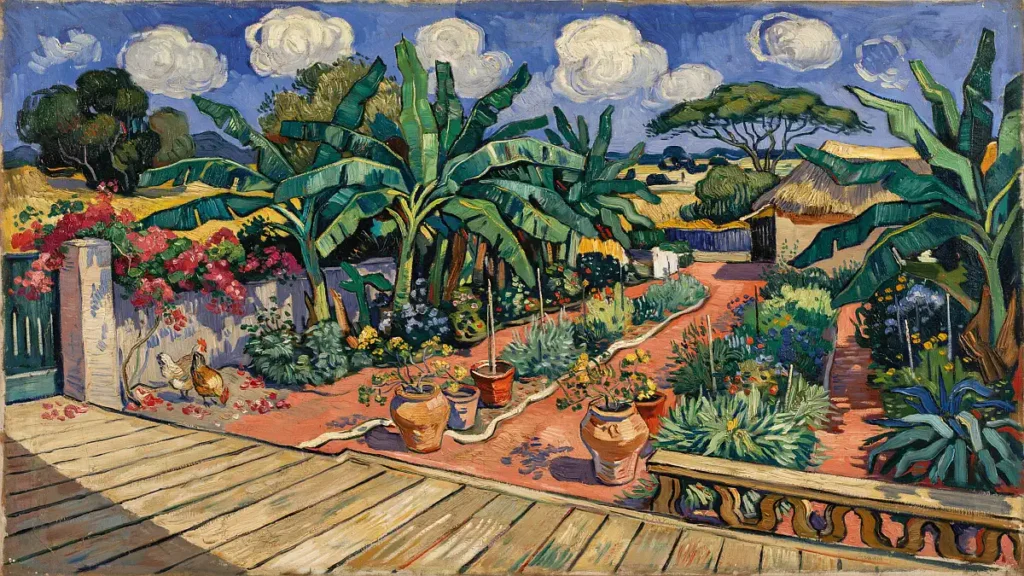
That’s where my relationship with nature, interiors and the idea of a rooted home began — watching someone transform a patch of tropical earth into something lush and alive, and understanding instinctively that a home isn’t what you buy, it’s what you build. Slowly, intentionally, with your hands in the soil.
I saw the same quality in the countries we lived in. In Africa, wood is plentiful and cheap, and the furniture that came with it was hand-carved — joints fitted by eye until they sat just so. No instruction manual, no kit. Each piece shaped to fit the next, the artisan’s hand visible in every stroke. There was a quiet competence in that work — the same quality I recognised later in my Opa, who had two left hands practically but designed his own darkroom and developed his own photographs, and let my brothesr and I loose in his workshop with offcuts and our own ideas. His neighbour built his own cabin by hand, then taught himself model shipbuilding — not from kits, but shaping every single plank himself from scratch.
What connected all of it — the African craftsman, my Opa in his darkroom, a neighbour carving a ship’s hull in a forest in the Netherlands — was not the material. It was the standard. A refusal to accept approximately right when exactly right was achievable, even if it took longer.
Since then I’ve lived in apartments and houses, on hectares of land and in tight urban spaces. I’ve had tropical gardens in Benin and Kenya, navigated the urban jungle of New York, and somehow squeezed a wildlife haven into 960 square metres in South Africa. I’ve learned what works in the tropics and what works in the cold, what makes a small space feel generous and what makes a large one feel hollow. Thirty countries of interiors education, none of it from a design school.
The house that started it all
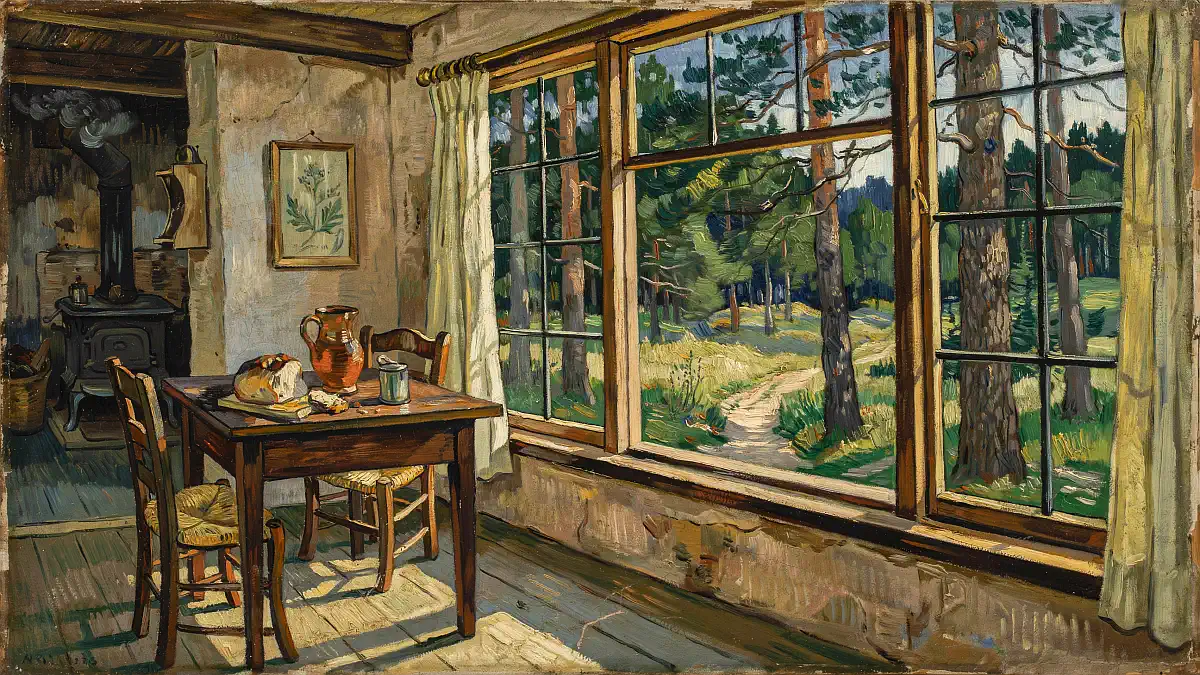
There is one house I come back to in my mind more than any other. My grandparents’ home in the Netherlands, near Nuenen — a small town you might recognise as the place where Van Gogh painted his early work, all dark earth tones and quiet forest light. The roads to their house were sand. The trees were mainly pines. Their plot was two acres, and behind them their neighbour had fifteen hectares of forest.
We would spend holidays wandering through that space — my brother and I cycling through the trees, the pine needles silencing everything, the light coming through in the particular way it only does in a northern European forest. Their home sat in the middle of it like something that had always been there. Deep wood, not painted. Large windows pulling the outside in. A quality of light inside that made the whole house feel warm even in winter.
My Opa was a village doctor — not wealthy in the way that word is used today, but the house had been designed precisely around who they were. My Oma was taller than average, so the kitchen worktop was raised ten centimetres. Not a luxury. Just precision. Just: this is her kitchen, so it fits her. I have thought about that worktop my entire life.
In the evenings, my Opa sat in his rocking chair, the dog at his feet, my Oma knitting. The silence was easy because they knew exactly who they were. There was no performance in it — just two people completely at home in a space that had been made for them, and for no one else.
That house is why I cannot bear painted-over wood. Why I think large windows are not a luxury but a necessity. Why I believe a home should feel as though it grew in its location rather than being placed there. And it’s the quiet blueprint behind everything I write on The Hazel Cottage.
The dream I’m working towards
One day — and I mean this seriously, not wistfully — I will live in either a forest in Washington State, Oregon or Pennsylvania, or on a hillside with a view of the sea.
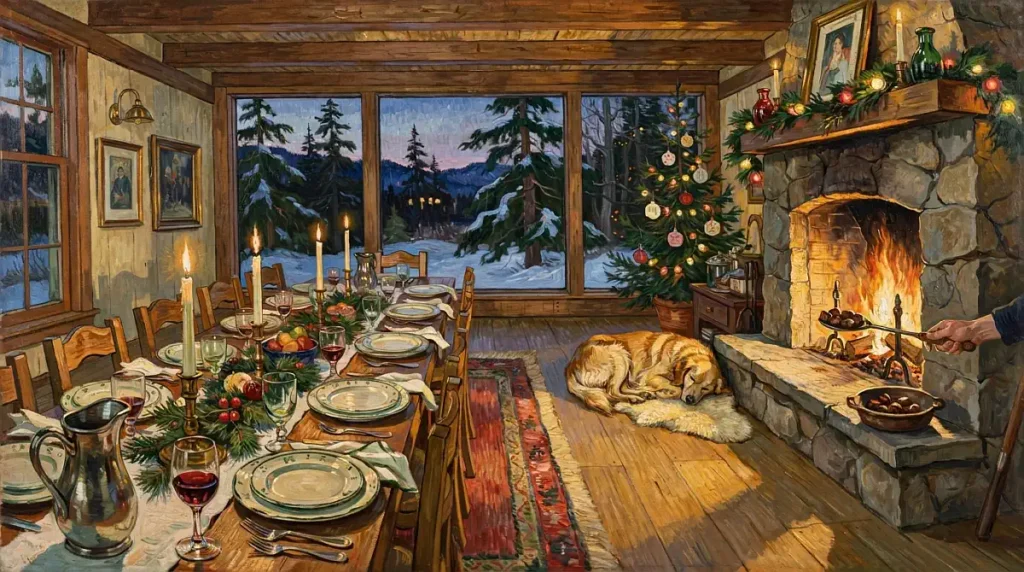
The forest version looks like this in my mind: you turn off the main road, drive down a winding lane through the trees, and just as you round the last corner, there it is. A house built for deep varnish woods, not painted. Large windows creating a pool of warm light that spills out into the dark around it. Children and grandchildren arriving for Christmas, chestnuts roasting, a raclette cheese melting slowly by the fire, hot chocolate spiced with a blend we copied from a visit to the Le Caillet chocolate factory in Switzerland. Snow, if we’re lucky.
The hillside version is different but the feeling is the same — that particular peace of being perfectly warm and sheltered while outside, storms roll in off the sea. Cocooned. Rooted. Completely at ease.
Both of these homes exist clearly in my imagination. The Hazel Cottage is, in many ways, the long process of designing them.
Where we actually live right now
Currently, we are in South Africa — a temporary chapter on the road to retirement. We live on a country estate where, it’s fair to say, we are that house. The neighbourhood favours the manicured golf-estate look. We have bougainvilleas grown into a green cave on the street side where neighbours stop to take photographs. We have a dense hedge of shrubs and tightly packed trees rather than a clipped border. We have, at last count, four Coucals — extraordinarily shy birds — who have decided our garden is safe enough to call home. We started with one. The worm farm is non-negotiable. The composting is ongoing. The solar panels are in.
We are not anti-modern. This is also why I am slow when it comes to decorating our own spaces. Some people find my choices odd — there is a wall in our home painted grey with a bright orange stripe through the middle, and I understand that sounds strange. But the decisions are slow because I am waiting for right. Not approximately right. The same way the artisan waited for the joint to fit. The same way a worktop gets raised ten centimetres, not nine, not eleven.
The air fryer is a family staple — we give one to everyone we know, genuinely believing it’s one of the more sensible ways to reduce energy use in a kitchen. If something makes sense, we adopt it. But the baseline is always nature first: grow what you can, waste as little as possible, make room for the wild things.
What The Hazel Cottage is about
This blog exists because I believe most home decor content is aimed at people who want to buy their way to a beautiful home, and that’s not how beautiful homes work.
The homes I’ve loved most — my grandparents’ forest house, the garden my father built in Nairobi, our current wildlife haven in South Africa — were never about the right furniture or the right trend. They were about attention. About choosing natural materials because they age well and feel honest. About making room for living things. About understanding that a home should feel like the most settled version of yourself, not a showroom that happens to have your name on the door.
The Hazel Cottage covers earthy cottage decor, cozy room ideas, farmhouse kitchen styling, indoor plants and slow living — always through the lens of natural materials, warm colour and unhurried intention. Everything here is written from genuine experience: thirty countries of homes, a lifetime of gardens, and a very specific idea of what I’m working towards.
The rest of the family
Food is at the centre of our home — always has been — so alongside The Hazel Cottage you’ll find our food blog at Whaleycooks.com, air fryer recipes at TheFryerist.com, picnic and outdoor dining inspiration at Picknickity.com, and family nutrition at PowerUpYourKids.com. The garden side of life lives at VerticalLiveGarden.com. And if you’re thinking about slowing down, retiring well, or transitioning into the best chapter of your life, that conversation happens at StraightFireLife.com.
They’re separate sites but they come from the same place — a belief that a good life is built deliberately, one small right decision at a time.
Closing — no heading, just a sign-off:
If you’re here because you’re looking for something warmer and more considered than most home content — something that takes natural materials seriously, that believes cozy has nothing to do with fairy lights, and that thinks the best interiors are the ones that look like they’ve always been there — then you’re in exactly the right place.
Pull up a chair. Stay a while.
— Samantha