9 Morning Rituals for a Cozy, Slow Start in a Natural Home
· thehazelcottage@mail.com

I grew up in a house where the morning rush set the mood for the whole day. Doors slamming. Toast burnt. Keys lost. That chaos followed me out of the door and into every conversation I had before lunch. Years later I build mornings that start quiet instead, and not because I have more time, because I do not. It is that the first sixty minutes decide the tone of everything after them.
These nine rituals are designed for apartment living with no special equipment. They work whether you have a studio or a house, whether you’re an early riser or someone who drags themselves upright ten minutes before they need to leave. Start with one or two. Layer in more as they stick.
1. How Do You Wake Up Without Jarring Yourself Alert?

Open curtains or blinds to let in bright indirect light near a window. Let natural illumination guide your first hour instead of artificial brightness. Your brain transitions from sleep to wakefulness more smoothly with soft, gradual light.
Research on sunlight and sleep regulation shows that morning light exposure aligns circadian rhythms, improves mood, and enhances cognitive performance. The effect is on timing rather than willpower: light early in the day pulls the whole rhythm forward, which is why the same bedtime feels different after a bright morning.
I jolted awake to a phone alarm for years, reached for the overhead light, and immediately felt behind. Then I moved my phone charger across the room, so I had to get up to turn it off. On the way back to bed, I opened the curtains. Within a week, I noticed I felt more alert, less irritable, and the mornings stopped feeling like a punishment.
If you wake before sunrise, a sheer curtain diffuses harsh light once the sun rises. If your room faces north or gets limited light, a timer lamp that gradually brightens can mimic the natural transition.
What if you are simply not a morning person?
Then most of this advice is written for someone else, and it is worth saying so. Morning-routine writing almost always assumes a body clock that wants to be up early, and roughly a third of people do not have one. Pushing an early start onto a late chronotype produces what researchers call social jetlag: you are awake, but your internal clock is still hours behind, and no amount of curtain-opening fixes that.
The natural experiment came when work schedules collapsed during the 2020 lockdowns. With the usual social time pressure removed, researchers found sleep timing shifted later and sleep quality improved for the people whose clocks had been fighting their alarms. The useful reading of that is not that mornings do not matter. It is that the rituals below are about the first hour after you wake, whenever that happens. Run them at eight, or at eleven on a Sunday. The sequence is what does the work, not the hour on the clock.
Takeaway: Tomorrow, open curtains before you touch your phone. Let the light lead.
2. What Does a Mindful Morning Beverage Actually Do?

Boil water, steep tea or grind coffee slowly, and sip for five to seven minutes before touching screens. This simple act steadies your pace and signals to your brain that the day is beginning with intention, not panic.
I gulped coffee while checking email for years, burning my tongue and my nerves in equal measure. Then I started a new rule: no screens until the mug is half empty. That five-to-seven-minute window became sacred. I’d sit by the window, watch the light change, and let my brain come online gradually.
The ritual isn’t about the beverage, it’s about the pause. Whether it’s tea, coffee, or warm water with lemon, the act of holding something warm, tasting it, and not rushing creates a buffer between sleep and the demands of the day. You’re not delaying your life; you’re arriving at it more fully.
Takeaway: Tomorrow morning, make your drink, sit by a window, and don’t touch your phone until the mug is half empty.
3. How Do You Wake Your Body Without a Workout?

Drink a glass of water first thing, then do a five-minute routine: neck circles, shoulder rolls, hip openers, and gentle walking around the room. This restarts circulation and alertness without requiring a gym or a change of clothes.
Stiffness from sleep makes the morning feel like a chore. A light stretch and hydration revive circulation and mood in minutes. I keep a water bottle by the bed, the first thing I do is drink half of it. Then, while the kettle boils, I do slow neck circles, roll my shoulders, stretch my arms overhead. It takes five minutes, but I feel like a different person by the time I sit down with my tea.
You don’t need a yoga mat or a routine. Just move. Roll your shoulders. Touch your toes. Walk around the room. The goal isn’t exercise, it’s waking up your body so your mind can follow.
Takeaway: Keep water by the bed. Drink. Stretch for five minutes. Notice the difference.
4. Why Does a Five-Minute Tidy Transform Your Morning?

Set a five-minute timer and return items to their designated spots. Straighten one small area, the entryway table, the kitchen counter, your desk. A clear surface creates mental space for the day ahead.
A cluttered space magnifies a cluttered mind. Research on environmental stress shows that visual clutter increases cortisol and makes it harder to focus. When I wake up to a messy kitchen, I feel behind before I’ve started. When I wake up to a clear counter, the day feels possible.
The five-minute tidy isn’t deep cleaning, it’s resetting. Put the dishes in the dishwasher. Wipe the counter. Put the mail in its tray. Straighten the cushions. Five minutes, done. Your future self will thank you when you walk into that room at noon.
Takeaway: Set a timer. Tidy one surface. Stop when it rings.
5. How Can a Three-Minute Plant Check Ground Your Morning?

Wipe dusty leaves with a damp cloth, check soil moisture with your finger, and rotate pots for even light exposure. This three-minute practice connects you to something alive while keeping your plants healthy.
Morning plant care doesn’t have to be a chore, it can be a grounding ritual. I walk through my apartment with a damp cloth, wiping the leaves of my pothos, fern, and the small fig by the window. It takes three minutes, but it’s the first moment I touch something living, something that grows slowly and quietly, and it sets a different tone for the day.
Research on the restorative effects of green space reports that even brief contact with plants reduces stress and restores attention. You’re not just watering your plants, you’re watering your own sense of calm.
Check the soil: is the top inch dry? Water only if it is. Rotate the pot a quarter turn so it grows evenly. Wipe the leaves. Done. Three minutes, and you’ve connected to something larger than your inbox.
Takeaway: Walk through your space with a damp cloth. Wipe, water only if needed, rotate. Three minutes.
6. What Does a Nourishing Breakfast Do for Your Morning?

Prepare a quick, balanced plate, protein plus fruit plus whole grain, in under ten minutes. A nourishing breakfast anchors your energy and prevents the mid-morning crash that leads to snacking and irritability.
I skipped breakfast to save time for years, then crashed by ten o’clock, reaching for whatever was fastest. The irony: I was spending more time distracted and hungry than I would have spent eating. Now I prep overnight oats the night before, or keep yogurt, fruit, and nuts visible on the counter. Five minutes, and I’m nourished.
The meal doesn’t need to be elaborate. It needs to be eaten. Sitting down, tasting your food, not eating standing over the sink. That five-minute pause is part of the ritual, it’s the difference between fueling and feeding.
Takeaway: Tonight, prep one quick breakfast option. Tomorrow, sit down and eat it.
7. How Does Writing Three Priorities Change Your Day?
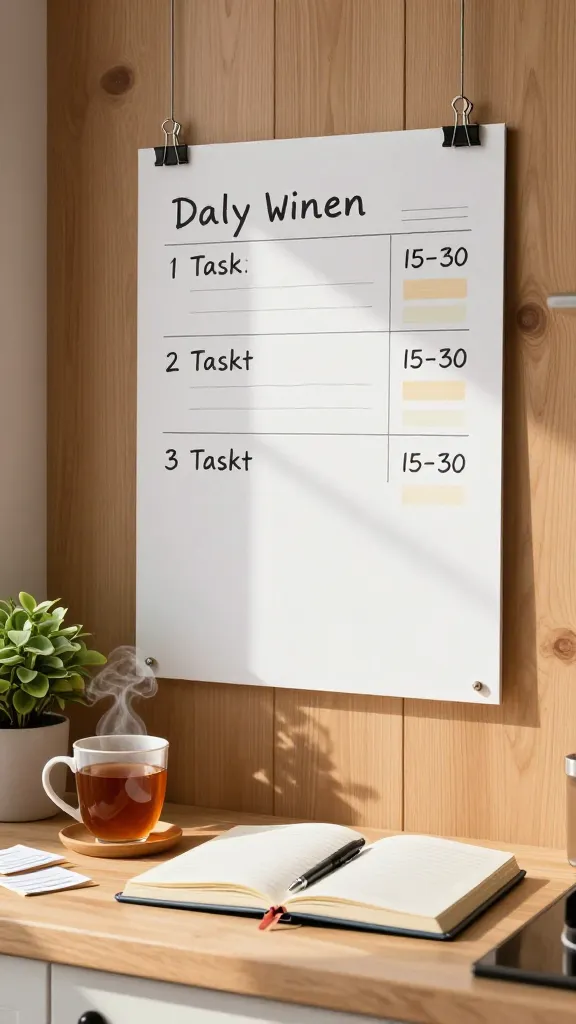
List three tasks you want to complete today and order them from most to least important. Keep the list visible, on the kitchen wall, by the door, in a notebook you carry. A written plan keeps you oriented toward what matters most.
Without a plan, the day stretches into aimless moments. You react instead of choosing. You finish other people’s priorities instead of your own. Writing three tasks, just three, creates a boundary between urgent and important.
I write mine on a small notepad by the coffee maker. While the kettle boils, I look at the list. Three things. Not ten, not twenty. Three. By noon, I’ve usually completed two, and the third gives me direction for the afternoon. The uncompleted ones carry over, and that’s fine. The point isn’t perfection, it’s intention.
Takeaway: Write three priorities. Put the list where you’ll see it. Let it guide you.
8. Why Do Sixty Seconds of Breathing Matter?

Close your eyes, breathe in for four counts, out for six counts, repeat for fifteen to twenty cycles. This sixty-second practice anchors your attention, reduces stress, and creates a moment of stillness before the day demands your energy.
Mental clutter is a morning drain. You wake up already thinking about emails, meetings, the argument yesterday, the task you forgot. Sixty seconds of focused breathing interrupts that spiral. Research on stress management shows that slow, deep breathing activates the parasympathetic nervous system, reducing cortisol and restoring calm.
I do mine sitting in the same chair where I drink my tea. Eyes closed, hands on my knees, counting breaths. In for four, out for six. By the time I reach twenty cycles, the mental noise has quieted. I open my eyes slowly and begin the day from a place of calm instead of reaction.
Sixty seconds. That’s all it takes. You don’t need a meditation app or a special cushion. You just need to stop, breathe, and count.
Takeaway: Sit. Close your eyes. Count twenty breaths. Open your eyes. Begin.
9. How Do You Create a Cozy Ambiance That Slows You Down?

Light a candle, drape a soft throw over your chair, choose a warm mug. These small touches signal a slow, intentional morning rather than a rush to finish errands. Environment shapes behaviour, make your space invite slowness.
The difference between a rushed morning and a slow one isn’t always about time, it’s about atmosphere. A cold, sterile room makes you tense. A warm, soft space makes you exhale. I keep a throw blanket on the living room chair, light a small candle while I drink my tea, and use my favourite mug, the one with the chip on the rim that I love anyway.
These aren’t luxuries. They’re signals. They tell your brain: this is a morning worth savouring. You don’t need expensive decor, you need one soft texture, one warm light, one object that makes you feel at home.
Takeaway: Add one cozy element to your morning space today. Notice how it changes the feel.
Morning Ritual Components Compared
| Ritual | Time Required | Primary Benefit | Best For |
|---|---|---|---|
| Natural light exposure | 2-5 minutes | Circadian alignment + mood boost | Waking without jarring |
| Mindful beverage | 5-7 minutes | Pace-setting + buffer | Slowing before screens |
| Gentle movement + hydration | 5 minutes | Circulation + alertness | Waking body without workout |
| Five-minute tidy | 5 minutes | Mental clarity + reduced cortisol | Starting with clear space |
| Plant check | 3 minutes | Connection to living things | Grounding + stress reduction |
| Sixty-second breathing | 1 minute | Parasympathetic activation | Calm before demands |
Frequently Asked Questions
What is the best order for a slow morning routine?
Start with natural light, then hydration and gentle movement, followed by a quick tidy and plant check. Finish with planning, a mindful breath, and a nourishing breakfast. This sequence primes your brain for focus while keeping you anchored in calm.
How long should a slow-morning routine take?
Between forty-five and ninety minutes works well for most people. Adjust by scaling back nonessential elements if you’re pressed for time, while keeping the core rituals, light, hydration, breath, and intention, intact.
What if I don’t have plants?
Substitute the plant ritual with another grounding practice: opening a window, stepping onto a balcony, or simply standing by a window and watching the sky for sixty seconds. The principle is connection to something larger than your inbox.
What if I wake up late?
Prioritise the core three: open curtains, drink water, breathe for sixty seconds. Even a fifteen-minute version of the routine resets mood and energy for the day. Consistency matters more than duration.
Conclusion
A slow morning isn’t about having more time, it’s about using the time you have differently. Open the curtains. Drink water. Move your body. Tidy one surface. Connect with something living. Write three priorities. Breathe. These nine rituals, done in any order, create a morning that feels like yours instead of something that happens to you.
Start with one. Tomorrow, just open the curtains before you touch your phone. Notice what changes. Then add another the following week. Over time, these small acts accumulate into a life that feels calmer, more grounded, and more intentionally yours. If you want to extend this calm throughout the day, my guides on Sunday rituals for a grounded home, seasonal home transitions, and intentional home design show how to build rhythm and calm into every part of your life.
Leave a Reply