10 Balcony Ideas for Earthy Indoor-Outdoor Living in a Small Space
· thehazelcottage@mail.com
When my grandmother moved from her forest house into a mass-produced apartment, the first thing she noticed was what was missing. The sound of leaves. The damp-earth smell after rain. The feeling of being surrounded by something alive. Inside, she got vinyl flooring that pretended to be wood. But the balcony overlooked a neighbour’s garden, and that became her project: portable glass panes against the wind, a wooden screen for a climbing flowering plant, natural stone tiles that hid soil stains and swept clean, and a three-part system of wheels, cloth covers and straw mulch that carried her pots through a northern European winter. That balcony was the part of her new home that still felt like hers.
If your balcony is a bare concrete slab, you can do the same with natural textures, a few hardy plants, and some care about privacy, shade and seasonal protection. Here are ten practical ideas for turning a small apartment balcony into an earthy retreat, whether you own or rent.
1. How Do You Ground a Small Balcony with Natural Flooring?
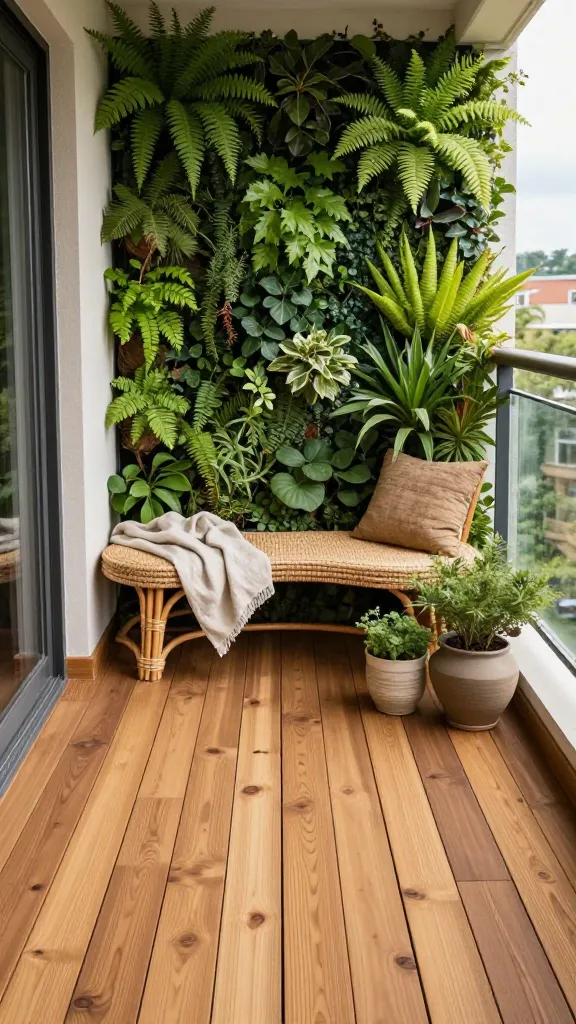
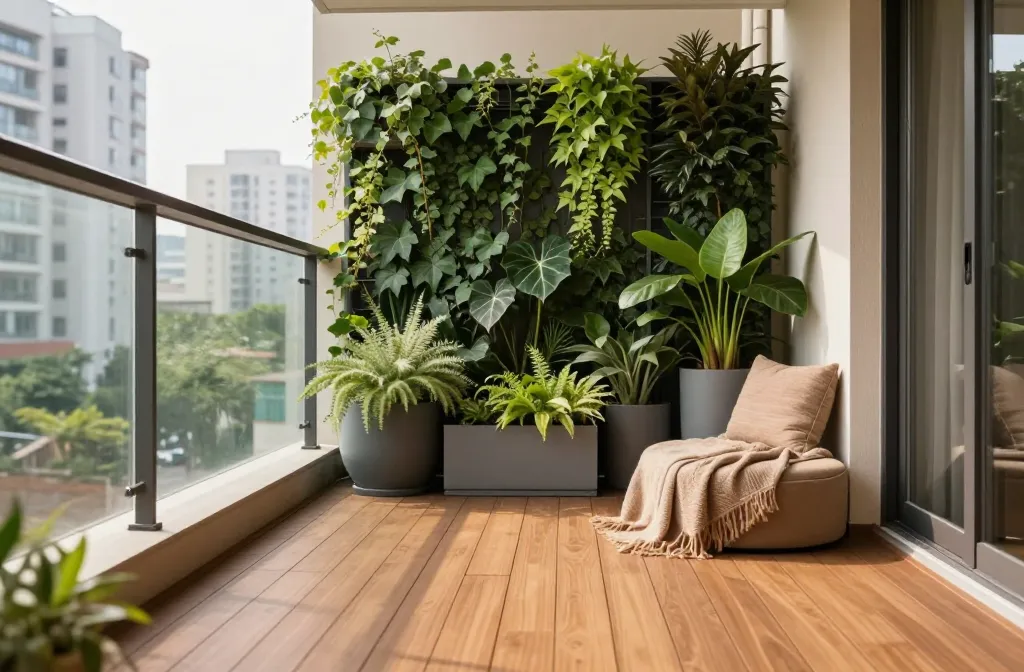
Interlocking composite deck tiles and a vertical planter grid turn a concrete slab into a defined retreat in an afternoon. Snap the tiles together without adhesive. Then hang lightweight planters in a grid so the greenery sits at eye level instead of only at your feet.
My grandmother chose natural stone for her balcony floor because soil stains vanished into the pattern and a quick sweep brought it back. That instinct was the right one. Container gardening basics from Penn State Extension note that balcony flooring has to cope with moisture, spilled soil and foot traffic without warping, which is exactly what composite tiles and stone do well.
Renting? Interlocking tiles are the answer. They lift out in minutes when you move, and they come in teak, acacia and composite finishes that read warm rather than plastic. Pair the floor with one vertical planter, even a simple lattice carrying ivy or pothos, and the balcony stops feeling like an afterthought.
How much weight can a balcony actually hold?
Less than most balcony makeovers assume, and this is the question nobody in this category asks. The HUD guide to design loads for residential buildings sets out the standard: under ASCE 7, a balcony is designed for 1.5 times the live load of the room it serves, which for an apartment works out at 60 pounds per square foot. Buildings permitted under older editions of the code may only have been designed for 40.
The New York Botanical Garden’s balcony guide is one of the few gardening sources that tells you to confirm your own limit before loading it.
The number that catches people out is saturated soil. A large planter that felt manageable at the garden centre can double in weight after a long rain, and a row of them along the outer railing is the worst place to put that load: on a cantilevered balcony, weight at the free edge does more than the same weight against the building. Keep the heavy pots close to the wall. Ask the building manager for the figure before you commit to a full living wall, and treat a storage bench full of wet compost as furniture, not decoration.
Takeaway: Lay down snap-together tiles and one vertical planter to anchor the space in a single afternoon. Confirm your load limit first.
2. What Are the Best Earthy Textures for a Small Balcony?
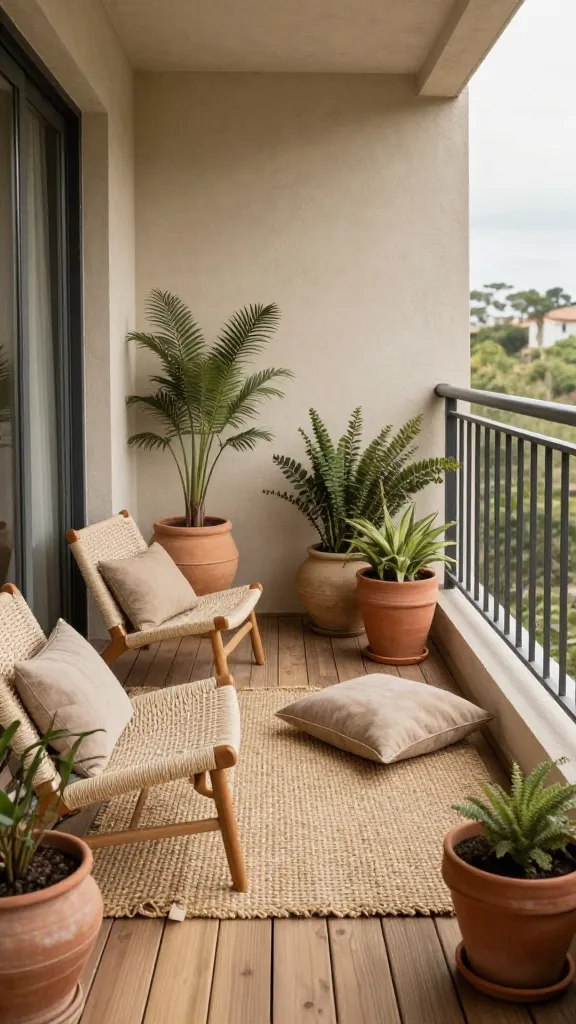
Layer three textures, one soft, one rough, one warm, and concrete starts reading as an extension of your living room. Keep to earth tones: sand, clay, sage, stone, warm wood.
Inside my grandmother’s apartment, the vinyl never lost its synthetic feel. The balcony did, and the difference was texture: stone underfoot, a wooden screen at shoulder height, terracotta at the edges. It had the grain of the forest she had left behind. Research on the restorative effects of urban green space reports that even small accessible natural areas are associated with lower stress and better mental wellbeing. Bare feet on jute feel different from cold concrete, and that difference is most of the job.
My parents had a balcony in France, on an old piggery converted into two apartments stacked one above the other. It was tiny, with a bare metal wire guardrail that matched the stone house not at all. They clad it in wooden slats, added shutters, and the family started calling the place the Heidi-house. One material, and the balcony stopped being an add-on.
Start with an outdoor-rated jute or sisal rug for softness. Add terracotta or unglazed ceramic for roughness. Finish with a woven chair or a teak bench. Three textures is the ceiling. Past that, a small balcony reads cluttered.
Takeaway: Introduce three earthy textures today, one underfoot, one in your pots, one in your seating.
3. How Do You Add Privacy to an Apartment Balcony?
A bamboo screen, trailing plants on railing hooks, or outdoor curtains give you separation without losing light. The most renter-friendly option is a tension-mounted bamboo screen. No drilling, and it stores flat.
My grandmother’s wooden screen did two jobs at once. It blocked the windows of the building next door, and it gave her climbing jasmine something to hold. By midsummer the screen had disappeared under flowers, and the balcony felt like a private garden rather than a ledge with an audience. The Royal Horticultural Society’s balcony guide suggests ivy, clematis and jasmine for exactly this: screening that softens a hard edge instead of building another wall.
Want privacy this week rather than next season? A bamboo roll clipped to the railing works in minutes. Outdoor curtain panels on a tension rod give you a fabric wall that moves in the breeze. And for anyone who cannot drill into anything at all, railing-mounted hooks and trailing plants get you there by the end of one growing season.
Takeaway: Add one privacy layer today, a bamboo screen, a curtain panel, or trailing plants on the railing.
4. What Furniture Works Best on a Tiny Balcony?
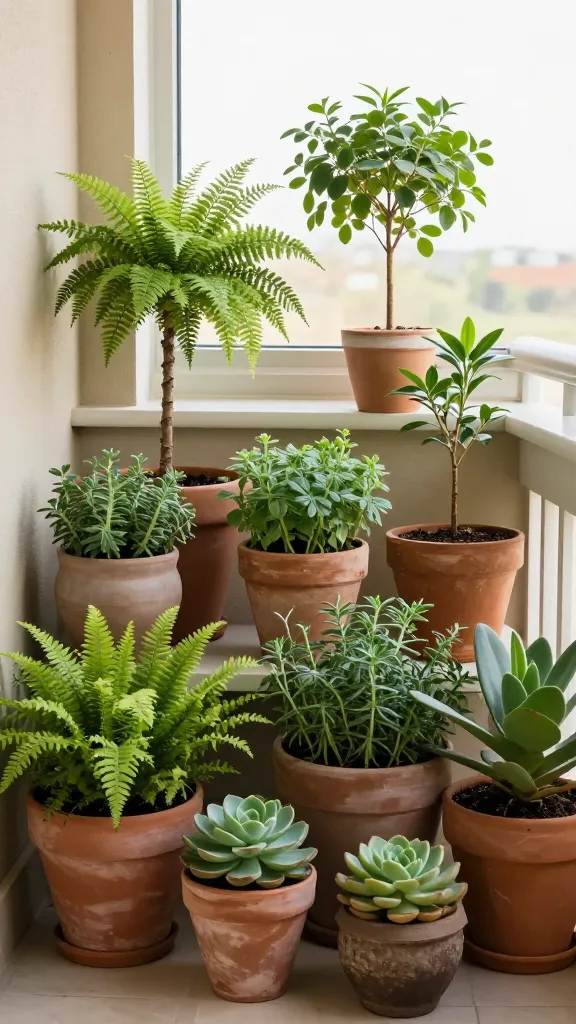
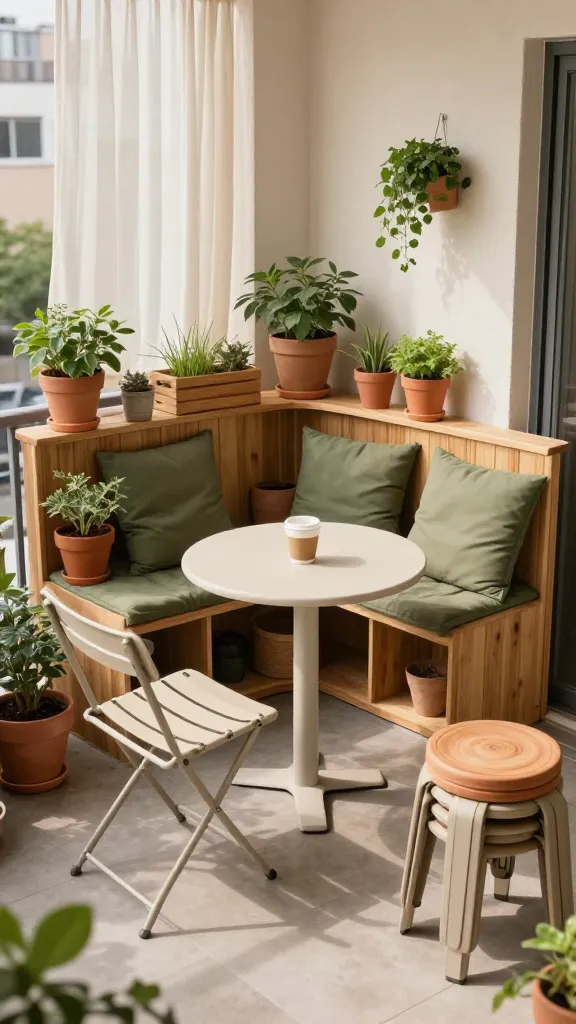
Folding bistro sets and modular loveseats carry a 60-square-foot balcony from morning coffee to evening company without crowding it. One rule covers most decisions: every piece should fold flat, stack, or do two jobs.
A folding bistro set handles breakfast, a laptop afternoon and a glass of wine, then goes against the wall when you want the floor back. A modular loveseat splits into two chairs, so the same furniture seats one comfortably or three at a push.
My parents’ French balcony was small enough that everything had to fold away into a corner. Since it lived outdoors year round, they bought an older set from a broccante, a secondhand shop, which claimed the pieces came from a farmhouse. The wood had weathered to a soft grey. That patina is why the balcony looked as though it had always been there, rather than decorated the previous weekend.
On a really narrow balcony, use a railing-mounted fold-down table. It brackets onto the rail, holds two plates and a glass, and drops flat afterwards. Penn State Extension also suggests open-framed furniture, slatted wood or thin metal, because solid pieces read visually heavier in a small space. Stick to teak, powder-coated steel, or all-weather wicker in earth tones.
Takeaway: Choose one folding or modular seating piece that adapts to two or three different uses.
5. Which Plants Thrive on a Small, Windy Balcony?
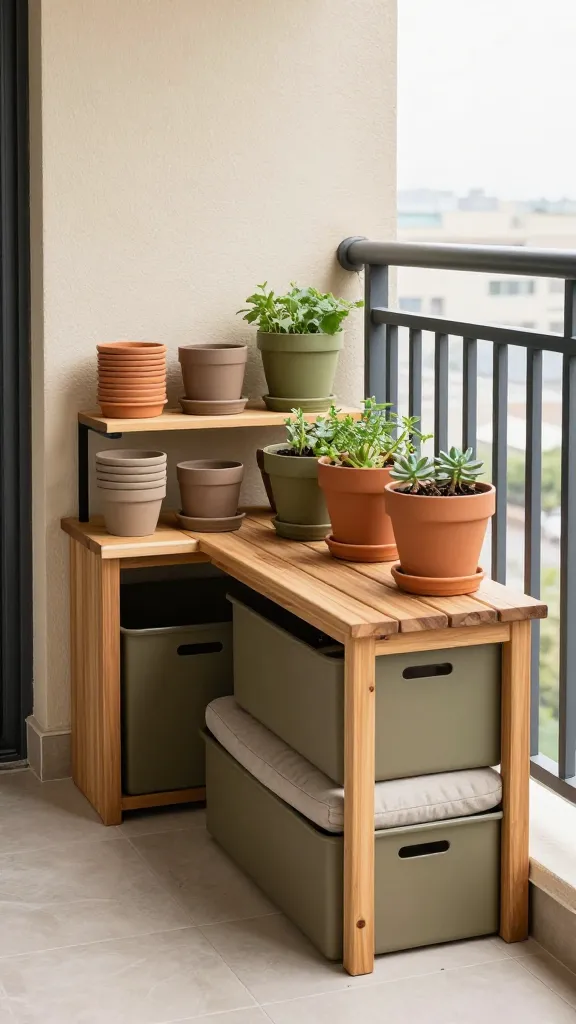
Drought-tolerant herbs like thyme and rosemary, compact ferns, and trailing pothos handle wind and shifting light better than delicate flowering plants. Group them by water need, and one watering round covers everything.
A balcony is a harsher place than a garden. Wind pulls moisture out of soil, sun bounces off concrete, and pots heat through on both sides rather than one. The University of Minnesota Extension’s container planning guide advises matching plants to your balcony’s actual exposure rather than to a catalogue: south-facing wants drought-tolerant varieties, north-facing wants shade-tolerant foliage. Wind is the variable most people underestimate, because it costs you water on days that do not feel hot.
My grandmother grouped her pots by thirst. Herbs by the kitchen door where she could reach them mid-cooking, ferns in the shadiest corner, succulents in the one spot that got full afternoon sun. A watering round took five minutes instead of fifteen, which is the difference between a routine you keep and one you abandon by August.
The Royal Horticultural Society recommends trailing plants for railing planters, compact herbs for shelves, and dwarf evergreens for structure in the corners. This table covers the reliable choices:
| Plant | Light | Water | Wind Tolerance | Best Pot Size |
|---|---|---|---|---|
| Thyme | Full sun | Low (weekly) | High | 6″ |
| Rosemary | Full sun | Low (10 days) | Medium | 8″ |
| Boston Fern | Indirect light | Medium (2x/week) | Low | 8″ hanging |
| Pothos | Low to indirect | Low (weekly) | Medium | 6″ trailing |
| Lavender | Full sun | Low (biweekly) | High | 8″ |
| Basil | Full sun | Medium (2x/week) | Low | 6″ |
| Sedum | Full sun | Very low | High | 4″ |
| Mint | Partial sun | High (2-3x/week) | Low | 6″ |
Takeaway: Group plants by water needs and match each to your balcony’s light exposure. Use the table above to choose the right plant for each spot.
6. How Do You Create Hidden Storage on a Small Balcony?
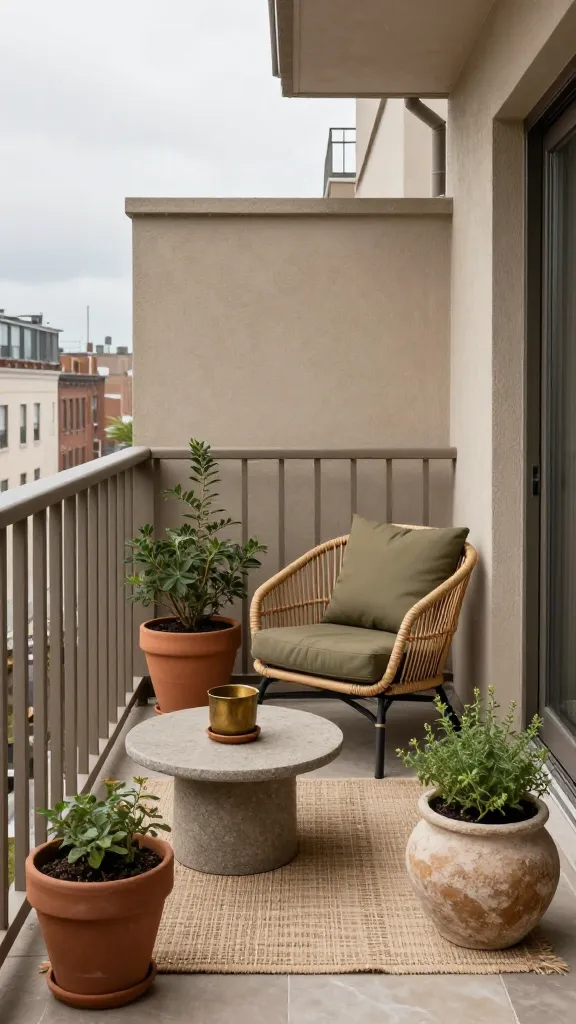
A weatherproof storage bench or stackable resin bins hide the supplies and give you somewhere to sit. Choose earth-tone wicker-look resin so the storage reads as part of the palette rather than as equipment.
A balcony loses its calm the moment tools, hose and empty pots start collecting in a corner. The fix is storage that disappears into the design. A slim bench with a lift-up lid swallows compost bags, gloves and secateurs, then seats two. Stackable bins in terracotta or sage slide under it.
My grandmother kept a shallow wooden tray under her bench. It caught drainage and gave her somewhere to set the watering can down. Hidden, practical, and made of the same material as everything else out there. The same logic runs through making a home feel more intentional, where cutting visual noise does more than adding anything new.
Takeaway: Add one piece of hidden storage, a bench, a bin, or a tray, that keeps supplies out of sight but within reach.
7. How Do You Add Shade and Wind Protection to a Balcony?
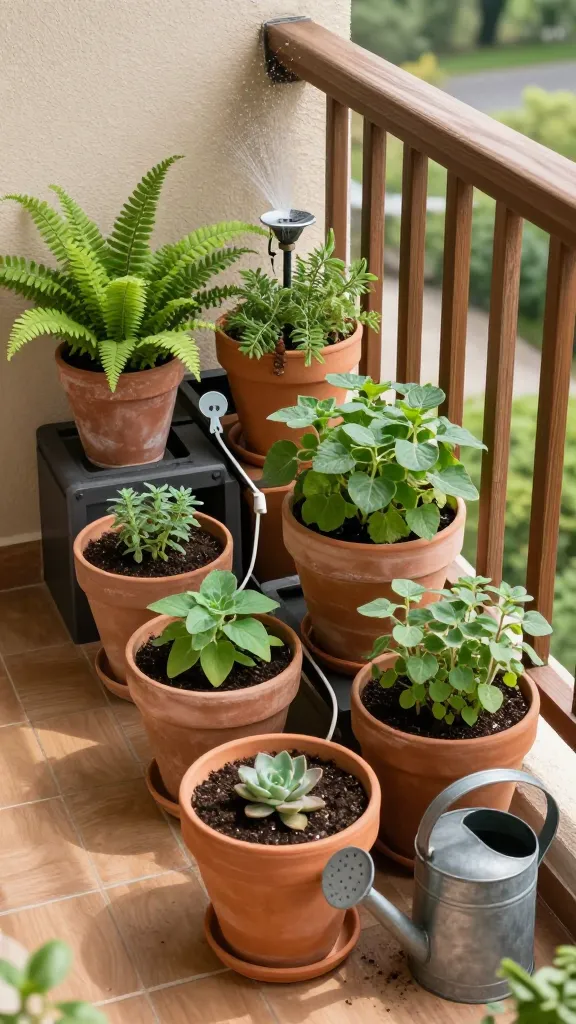
A cantilever umbrella or clip-on awning shades the balcony without eating the floor, because the base sits to one side and the canopy swings as the sun moves. Add a furniture cover for the days you are not out there.
My grandmother’s portable glass panes were her wind solution. Small movable panels, set out on rough afternoons and stored flat when the air was still. They turned a wind-battered ledge into somewhere she could sit with tea in October. The principle carries: you do not need a permanent structure, you need something you can adjust.
For shade, the cantilever design beats a centre-post umbrella on a small balcony every time. The base tucks under a chair or against a wall, the floor stays clear, and the canopy rotates rather than making you move your seat. UMN Extension makes the point that wind protection matters as much as shade, since exposed containers dry considerably faster than sheltered ones.
Cannot mount anything permanent? A clip-on screen or a freestanding bamboo panel blocks wind at railing height, which is where it does the damage. And a furniture cover pulled over the table when you go in keeps everything dry for the morning.
Takeaway: Add one adjustable shade or wind element, an umbrella, a screen, or a clip-on panel, to make the balcony usable in more conditions.
8. What Lighting Works Best for a Balcony at Night?
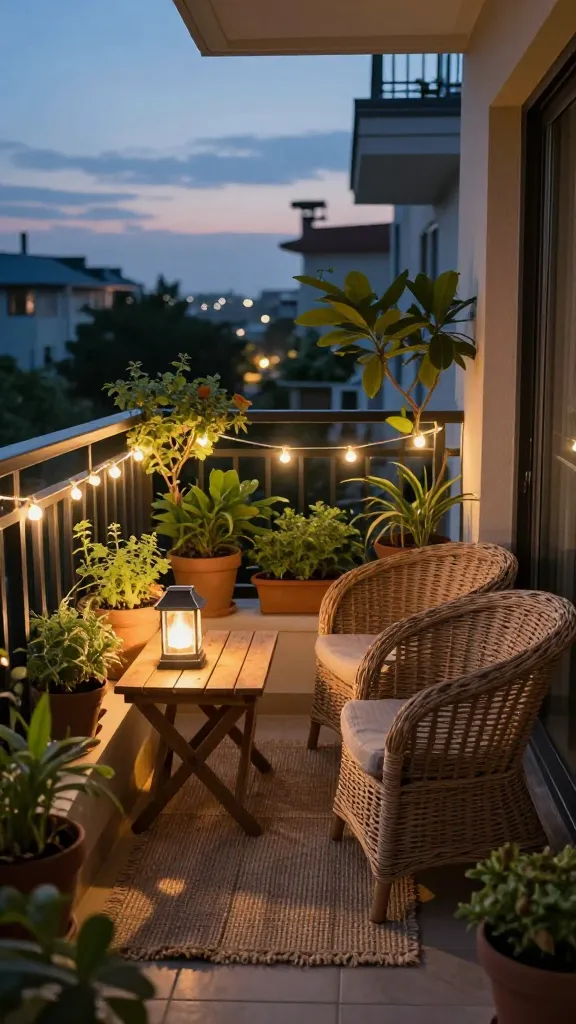
Warm-white LED string lights and solar lanterns extend the usable hours without glare or wiring. Wrap the string along the railing, hang one lantern at seating height, and stop there.
Lighting is what turns a balcony from a daytime afterthought into an evening room. Warm-white LEDs at 2700K to 3000K flatter the plants and the people among them. Cool-white and daylight bulbs do the opposite. They make a small balcony look like a car park.
Our neighbours had the top floor with nothing above them, so they strung lights right across the open space: large bulbs at a low orange wattage, smoky glass globes, copper wire between them. It read as modern and slightly retro at once. When they came on at dusk the whole balcony turned into a different room, and the plants looked softer than they had all day.
Solar lanterns charge through the day and switch on by themselves. Hang one or two at seating height and you have light without an extension cord through the window. Research on urban green space links access to pleasant outdoor areas with stress recovery, which is a reasonable argument for making yours usable after dark. The same instinct indoors produces a cozy rest corner.
Takeaway: Install warm-white lighting today, string lights on the railing and one solar lantern at seating height.
9. How Do You Protect Balcony Plants Through Winter?
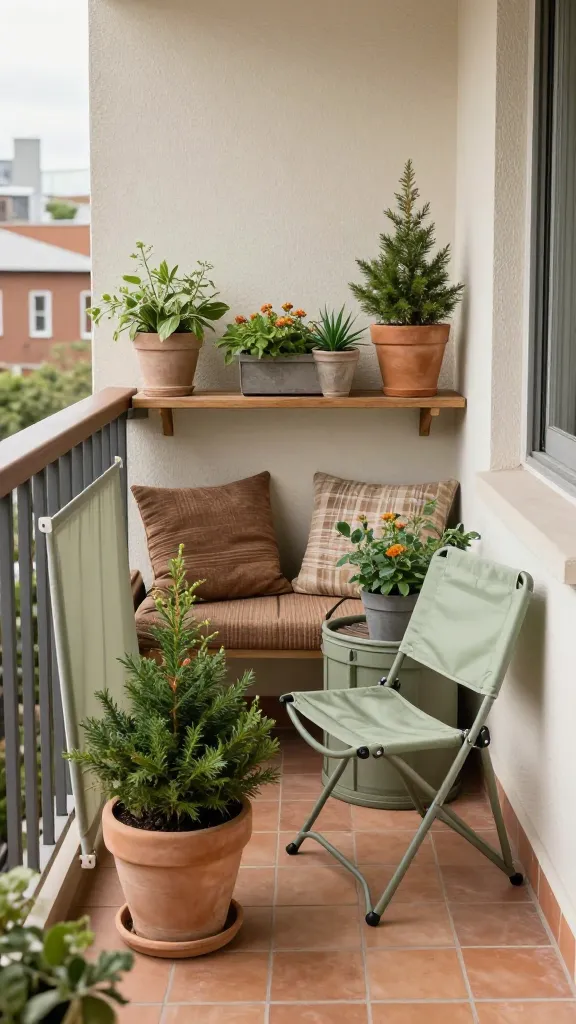
Roll tender plants indoors on wheeled saucers, cover hardy pots with breathable cloth, mulch the rest with straw. Match the layer to the plant’s actual cold tolerance rather than treating the balcony as one climate. It takes an afternoon and saves the lot.
My grandmother’s winter system was precise. Her most tender herbs sat on small wheeled saucers, and when the first frost threatened she rolled them inside to the kitchen window. Pots that could take a light freeze got breathable cloth that kept snow off without trapping damp against the stems. The hardiest planters got a thick straw mulch over the soil, insulating the roots without packing down into a mat.
The University of Minnesota Extension’s container guide explains why the layering matters: container roots are exposed on every side, so they lose cold tolerance faster than the same plant in the ground. Roll, cover, mulch. As a rough guide, bring tender plants in when nights drop below 10°C (50°F), cover the semi-hardy ones around freezing, and mulch anything rated to survive below zero.
Reverse it in spring, and do it slowly. Bring the indoor pots back out over about a week so they re-acclimatise to direct sun, take off the covers, refresh the straw. That rhythm is why her balcony carried on for decades instead of restarting every March. The same seasonal botanical ideas guide the indoor version of the swap.
Takeaway: Sort your plants into three groups, tender (bring in), medium (cover), hardy (mulch), before the first frost.
10. What’s a Simple Weekly Maintenance Routine for a Balcony?
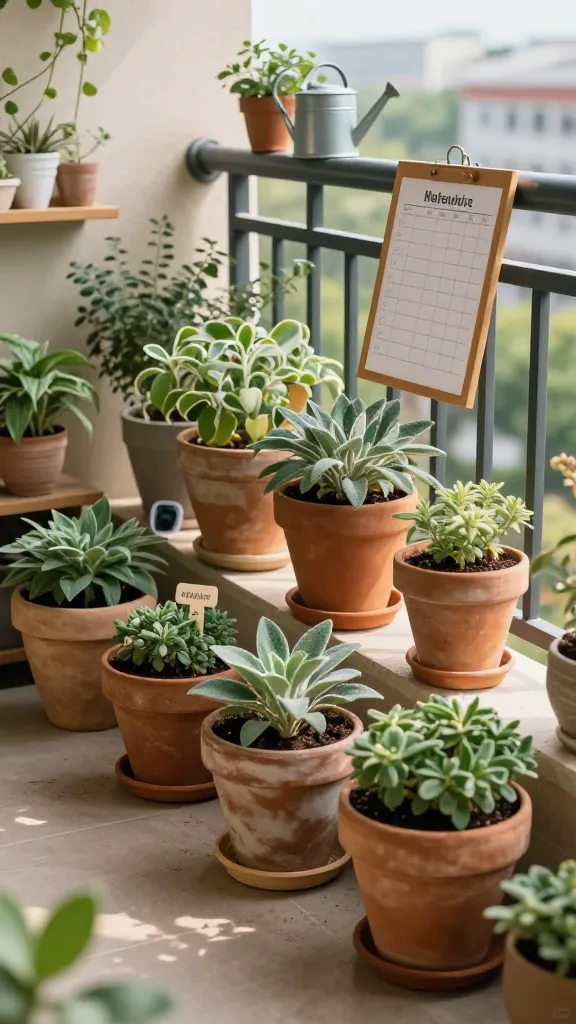
Water when the top inch feels dry, rotate pots monthly, and give the balcony fifteen minutes a week. That routine catches most problems while they are still small.
Balcony plants need less attention than they appear to, provided the attention is regular. Penn State Extension recommends testing soil moisture with a finger rather than watering to a schedule, because exposure varies across a single balcony and even along one railing. Overwatering kills more container plants than drought does, since saturated soil starves the roots of oxygen, so the finger test protects against the more common mistake.
The fifteen-minute check, in order. Press a finger into each pot and water only the dry ones. Look at the drainage holes, and clear any that have blocked with a skewer. Then read the leaves: yellowing means too much water, crisp edges mean too much sun or too little water, sticky residue means pests. Deal with pests the week you see them, using a spray of water and insecticidal soap.
Once a month, turn each pot a quarter rotation so growth stays even instead of leaning at the light. Once a season, go deeper: refresh the top layer of soil, cut out dead growth, swap in whatever suits the months ahead.
Takeaway: Schedule a fifteen-minute check every Friday, soil, drainage, leaves. That’s the entire routine.
Frequently Asked Questions
How do I decorate a small apartment balcony on a budget?
Start with three affordable changes: snap-together composite deck tiles (usually under $50), a jute outdoor rug, and railing-mounted planters, which together tend to land under $150 and all come with you when you move. Add battery string lights for the evenings.
What plants are best for a small balcony?
Drought-tolerant herbs like thyme and rosemary for sunny spots, compact ferns for shade, trailing pothos for railing planters. Group them by water need so a single pass waters everything.
How much weight can my balcony hold?
Residential balconies are typically designed for 60 pounds per square foot under current code, though older buildings may only be rated for 40. Confirm the figure with your building manager before adding a living wall or large planters, and keep the heaviest pots close to the building wall rather than out at the railing.
How do I make a small balcony feel bigger?
Use the vertical space with hanging planters, keep the floor clear with folding furniture, and hold pots and textiles to one palette. A mirror on the back wall reflects sky and greenery, which adds depth without costing floor space.
How do I add privacy to my apartment balcony without blocking light?
Trailing plants on railing hooks, ivy or jasmine or clematis, screen the sightline while still passing air and light. For something immediate, a bamboo roll clipped to the railing blocks the direct view from the balconies opposite and still filters daylight through.
A small balcony does not need a renovation to become a retreat. Start with a defined base, natural flooring and one vertical planter, then work outward: earthy textures, a privacy layer, plants matched to your actual conditions, furniture that folds, storage that hides, light that carries the evening. My grandmother turned a standardised apartment balcony into a forest substitute with stone tiles, a wooden screen and a winter system that worked for decades. My parents did it in France with slatted wood and a secondhand bistro set. Both started with one Saturday.
[…] 10 Balcony Ideas for Earthy Indoor-Outdoor Living in a Small Space […]